
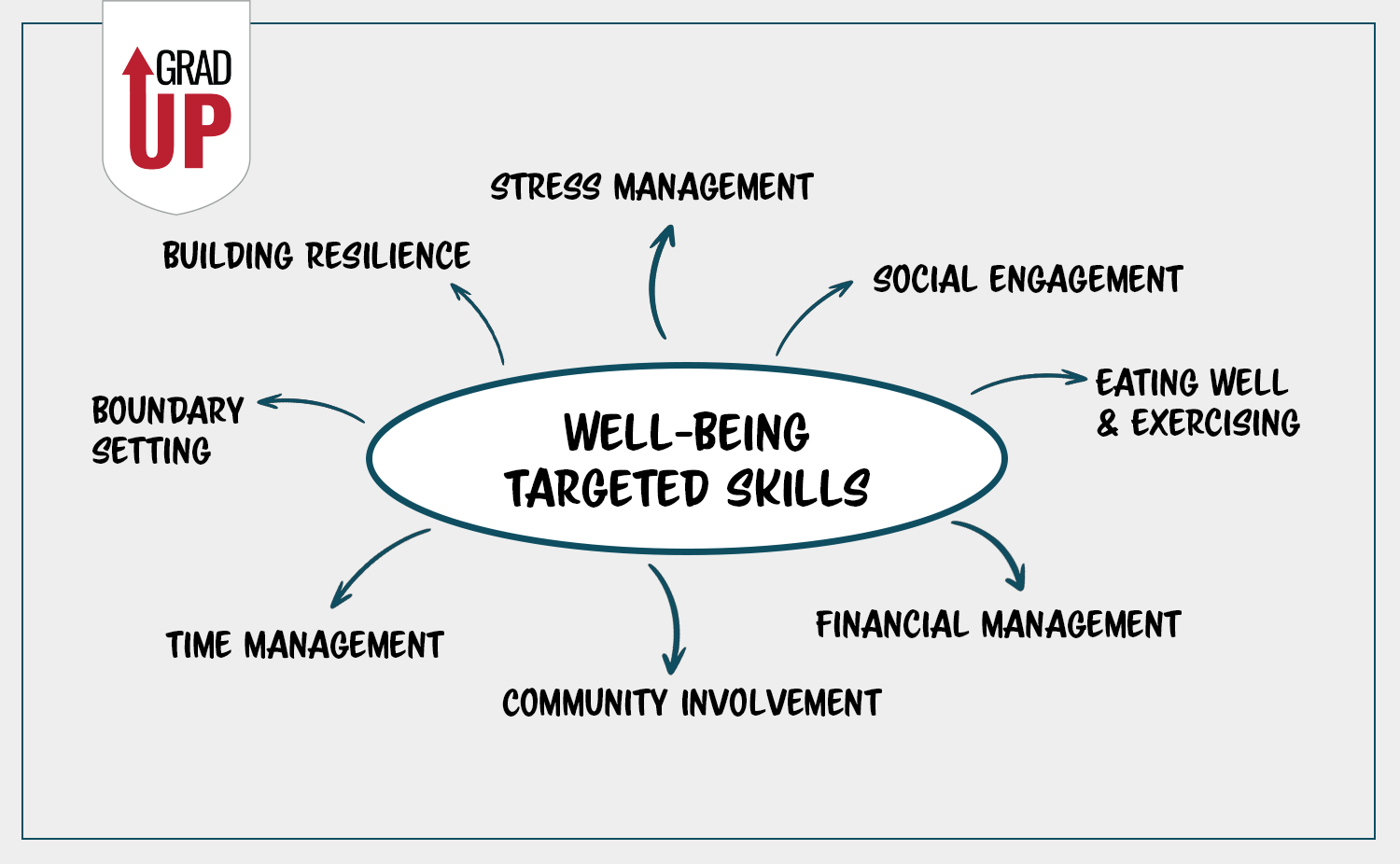
Stress reduction, Social engagement, Physical activity, Financial management, Emotional intelligence, Time management, Boundary setting, Building resilience

Living a balanced and fulfilling life involves finding purpose, building strong relationships, and maintaining overall well-being. This includes connecting with your passions, engaging in your community, nurturing social connections, prioritizing physical health, and managing finances effectively. 

GradUP: Well-being Key Topics

  • Purpose – Connecting to your goals, passions, interests, and values that motivate your decisions toward your personal and professional development
  • Community – Connecting to people and organizations that are most important in your life and being involved in your community. Fostering relationships and engaging with your various identities to stay connected with your authentic self
  • Social – Understanding your needs for personal connections and prioritizing these connections in your life. The ability to relate to and interact with others to build healthy relationships and have pleasant experiences
  • Physical – Maintaining a healthy body through nutrition, exercise, sleep, preventative medical appointments, and avoidance of harmful habits
  • Financial – Understanding your finances and recognizing that financial stressors impact all areas of your life. Managing finances and debt, gaining autonomy and planning strategically for short- and long-term goals


GradUP: Well-being Resources

Well-Being and Involvement
  • UGA Well-Being Resources
    UGA Well-Being Resources promote student success by encouraging a more active, healthy, and engaged student community, providing both clinical and non-clinical resources on campus, including digital/online resources.
  • Graduate Peer Support Network
    Grad school can feel like a lot—endless due dates, late-night stress, and wondering if everyone else has it figured out. The Graduate Peer Support Network (GPSN) is here so that you don’t have to navigate it alone. Sponsored by the Graduate School and led by graduate students from schools and colleges across campus, GPSN offers informal, peer-led support sessions where we talk about common struggles like procrastination, imposter feelings, burnout, and more.
  • Student Care & Outreach
    Student Care & Outreach (SCO) is the starting point for students who experience complex, hardship, and unforeseen circumstances. SCO operates as the hub of care and support providing individualized assistance and tailored interventions to students by coordinating resources and facilitating effective referrals to appropriate resources, including emergency funds.
  • Ombudsperson
    The student ombudsperson is a designated individual who serves as an independent, neutral, and informal resource for UGA students. Ombudspersons are advocates for fairness, and they function as a source of information and referral.
  • Student Involvement Network
    Get involved with student-led chapters of professional associations as well as graduate program-based student organizations and the Graduate Student Association, open to all UGA students.
  • University Health Center
    In addition to primary and specialty health clinics and mental health services, the UHC provides student programming focused on health promotion topics.
  • Recreational Sports / Ramsey Student Center
    The Ramsey Center serves as the hub of both indoor and outdoor physical and recreational activities. From group fitness classes to personal training, from intramural to club sports, as well as the natatorium, indoor track, climbing wall, and the opportunity for recreational trips, there is something for every level of fitness. Rec Sports also offers Fitness Buddies, providing students with a supportive, community-based fitness experience that fosters accountability and encourages an active lifestyle. The Graduate Student Well-Being Challenge is held in fall and spring.
  • Global Student Engagement
    Student organizations, International Coffee Hour, and other resources to support the internationalization of campus and the unique needs of international students.
  • Immigration Services
    Housed in the Office of Global Engagement, this is a great resource for information about your legal status in the U.S., employment benefits allowed to international students, and all other information relating to your non-immigrant status.  Email them at immigration@uga.edu, and find your student immigration advisor.
  • Student Veterans Resource Center
    The SVRC provides a point of contact and engagement for student veterans.
  • Engage Georgia
    The Engage GA platform is a central space where graduate students can find out about upcoming volunteer opportunities both on and off campus. The platform allows individuals to identify opportunities of interest, track their service when they register through the platform, and measure their impact in the community.
Financial Literacy

Financial Wellness Workshop Videos:

  • Funding a Graduate Degree
    Join Beth Lovern, Ph.D, the Graduate School’s Director of Fellowships and Scholarships, for this overview of the types of funding available for graduate degrees.
  • Financial Literacy for Graduate Students — Presented by the Office of Student Financial Aid, Peer Financial Counseling Program, this workshop teaches students how to evaluate their personal financial situation by assessing their total debts, savings, housing costs, and credit scores. Students will be exposed to different debt payoff methods, including the Snowball and Avalanche strategies. Students will also learn how to formulate a budget and properly calculate various expenses including housing costs. Students will learn about credit scores and how to properly use and manage credit cards. Finally, students will learn about student loan repayment and joining the workforce. The goal of this workshop is to empower graduate students to feel confident when making important financial decisions.
  • Making it on a Graduate Student Budget — Presented by the Office of Student Financial Aid, Peer Financial Counseling Program, this video will teach you information regarding budgeting, including the definition of a budget, five steps for managing your budget, types of budgeting methods, types of budgeting apps, and tips/resources for budgeting. The goal of this workshop is to provide you with information and resources for managing your daily finances in a way that best fits your personality.
  • Graduate Student Loan Borrowing — Presented by the Office of Student Financial Aid, Peer Financial Counseling Program, this video covers information on Federal Student Loans, Private Student Loans, borrowing smart, loan resources, and loan scams. The goal of this webinar is to help you make smart borrowing decisions for your educational expenses.
  • Debt & Debt Payoff — Presented by the Office of Student Financial Aid, Peer Financial Counseling Program, this workshop will explore practical strategies to manage and eliminate debt effectively. Participants will learn how to calculate the debt-to-income ratio and compare payoff methods such as the Snowball and Avalanche strategies. Through this presentation, students will have the ability to determine the best approach for their financial goals. The goal of this workshop is to promote smart borrowing, understand interest rates, and build healthy habits to support long-term financial stability.
  • Savings — Presented by the Office of Student Financial Aid, Peer Financial Counseling Program, this workshop teaches students how to create an emergency fund, set short and long-term savings goals, and understand the importance of paying themselves first. This workshop highlights creative ways to save and the benefits of high-yield savings accounts. The goal of this workshop is to promote consistent habits that can turn small contributions into significant financial progress over time.
  • Credit Reports, Credit Scores, & Credit Cards — Presented by the Office of Student Financial Aid, Peer Financial Counseling Program, this video covers information on the following topics: credit reports vs. credit scores, what’s in a credit report, the major credit bureaus, who uses your credit report, what is a credit report used for, where can I get my credit report, credit report mistakes & identity theft, what’s a credit score, what does your credit score impact, how to properly use credit cards, how do you start building credit, credit myths, debt payoff strategies, and your credit rights.
  • Leasing Smart: Housing — Presented by the Office of Student Financial Aid, Peer Financial Counseling Program, this video covers information on what’s in a lease, leasing terms, budgeting for housing, renter rights, and identifying rental scams.


Upcoming Events

No upcoming events.


Unlocking potential. Building futures.

Apply Today