


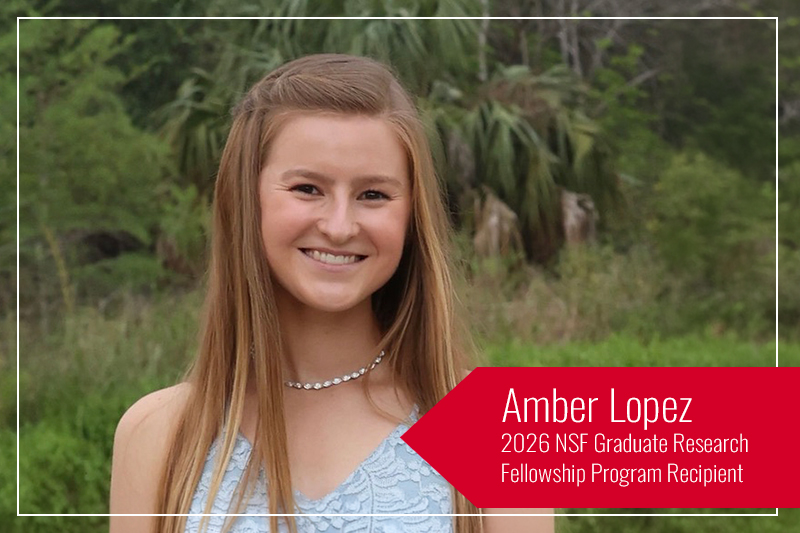
photo courtesy of Amber Lopez
Amber Lopez explores how tropical cyclones shape coastal flooding in Puerto Rico, with the goal of helping communities better understand and prepare for the impacts of extreme weather.
A master’s student in civil and environmental engineering at the University of Georgia, Lopez is a National Science Foundation Graduate Research Fellowship Program fellow. She uses ocean circulation modeling to simulate synthetic tropical cyclone events and evaluate resulting flood depths and extents.
She analyzes how different characteristics of tropical cyclones contribute to overland flooding, with plans to publish her findings as part of her master’s thesis before continuing to a doctorate in a related area of environmental and water research. Her research also focuses on translating complex modeling into information that can be useful beyond the research community. Lopez uses her findings to create flood maps and outreach materials for Puerto Rico’s residents, helping communicate the potential effects of coastal flooding in ways that can support greater awareness and preparedness. By combining engineering, environmental research, and public outreach, her work aims to better understand the ways tropical cyclones can affect vulnerable coastal communities.
Receiving her award was an unforgettable moment for Lopez. “I was ecstatic and in complete shock when I received the award,” she recalls.
The news arrived on a Sunday evening while she was attending her church’s small group. When she opened an email notification from the NSF and saw the news, she was so surprised that another member of the group briefly thought her reaction was directed at him. Instead, Lopez was simply sitting in amazement at the recognition.
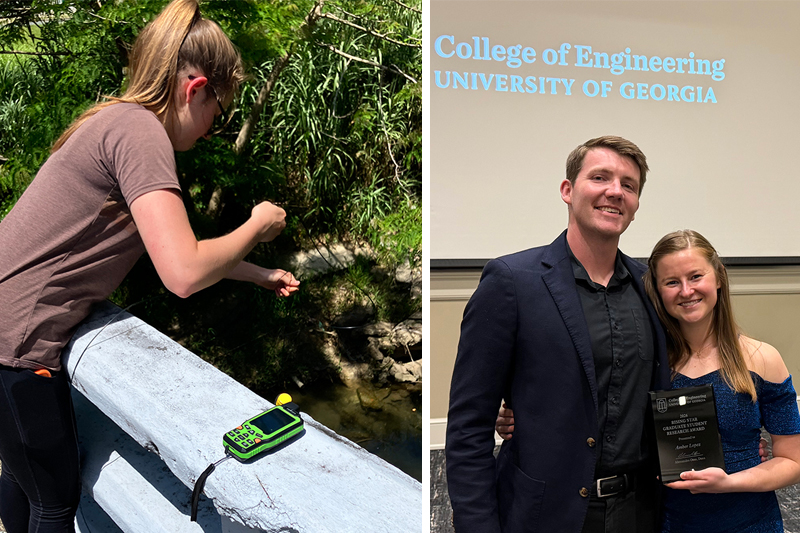
photos courtesy of Amber Lopez
Lopez’s graduate journey has also been shaped by the people who supported her as she adjusted to a new environment and challenged herself in a new field. She moved to Athens the day after graduating from the University of Florida, knowing no one at UGA. Throughout the transition, her parents, family, and close friends provided the emotional support that helped her navigate the challenges and successes of graduate school. She also credits her boyfriend as a constant source of encouragement and affirmation as she ventured into a research area beyond her traditional focus and outside of her comfort zone.
Lopez discovered UGA’s civil and environmental engineering program through an American Geophysical Union job posting. She knew she wanted to attend a respected university in the Southeast and was interested in expanding her background into new areas of water-related research.
“When I read through a job posting about coastal flood engineering, my interest piqued, and the rest is history.”
Her path to engineering also presented a personal challenge. With an undergraduate degree in soil and water sciences rather than engineering, Lopez recalls, “My greatest challenge has been learning how to see myself as an engineer.”
As she reached milestones in her research and developed the skills needed to think and conduct research like an engineer, she gained confidence in her abilities. Today, she says she can confidently recognize that she has the skills necessary to be an engineer, even as she continues to work through the self-doubt that can accompany such a transition.
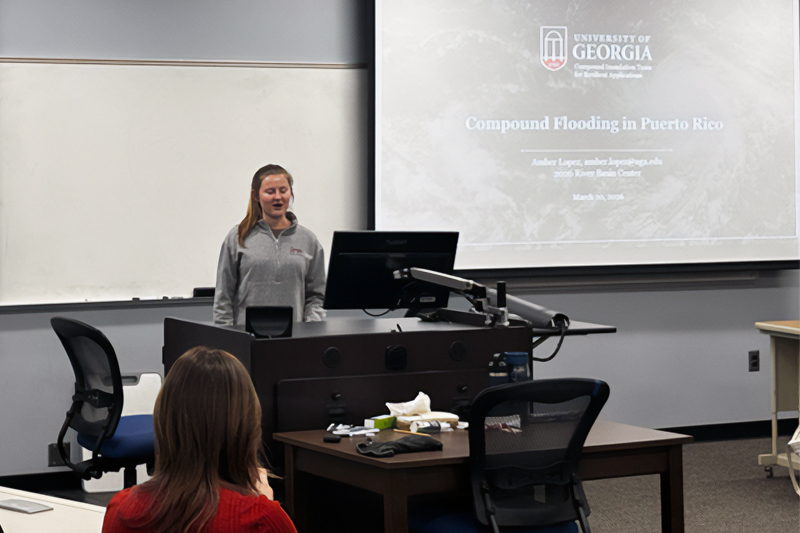
photo courtesy of Amber Lopez
Lopez’s academic journey has also taken her far beyond Athens. During her undergraduate years, she participated in NSF International Research Experience for Students programs in Ghana and Ecuador and studied abroad in Scotland as an exchange student. Since beginning her master’s at UGA, she has traveled to Puerto Rico and Colorado through National Center for Atmospheric Research fellowship and workshop programs.
Each experience, she says, has taught her lessons about research, different places and cultures, and herself. These opportunities have shaped her perspective and strengthened her desire to continue pursuing research that allows her to learn from new environments.
Outside her research, Lopez finds focus and clarity by spending time outdoors. Whether running with her boyfriend or hiking with her dog, she enjoys using time in nature to disconnect from her research and appreciate the world around her. As she continues exploring the intersection of engineering, environmental science, and water research, Amber Lopez is using her work to better understand coastal flooding and help communities prepare for the challenges posed by tropical cyclones.
The NSF GRFP is a highly competitive national fellowship that supports outstanding graduate students engaged in scientific research in STEM and STEM education disciplines who demonstrate the potential to be high achieving scientists and engineers.
The UGA Graduate School offers webinars and workshops to help aspiring NSF GRFP fellows navigate the application process.
More information on the Graduate School’s offerings.
More information on the NSF GRFP.


