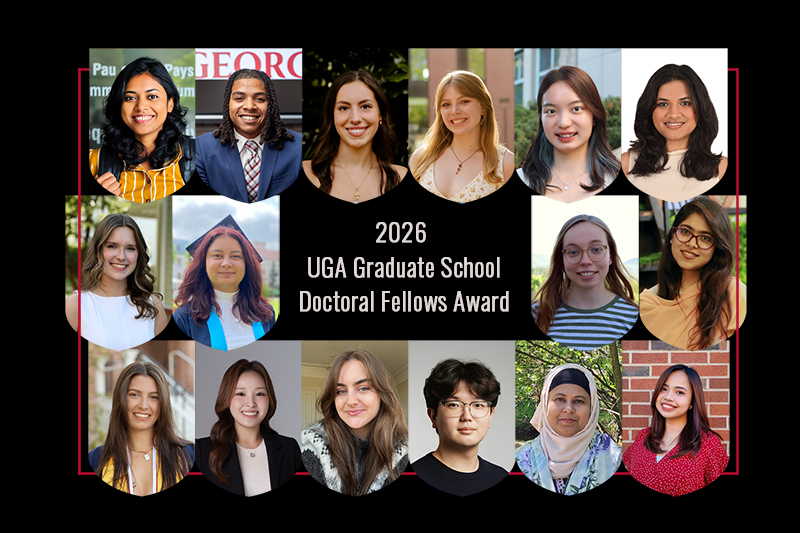
Congratulations to the 2025 Recipients

The Graduate School Doctoral Fellows Award is designed to recruit highly competitive students who will advance the research and scholarship mission of the University. Selected recipients come from various disciplines across campus.

Aidan Bobholz is a doctoral student in the Institute of Plant Breeding, Genetics, and Genomics at the University of Georgia, working under the guidance of Dr. Zenglu Li. His research focuses on the genetic improvement of soybeans using AI-driven predictive breeding.
Bobholz is from Randolph, Wisconsin where he grew up around agriculture and row crop production. He attended Iowa State University, where he majored in Agronomy and Seed Science, and minored in Data Science and International Agriculture, graduating with Cum Laude honors. While at Iowa State, he was awarded the Senior Award for Excellence in Agronomy, the National Student Recognition Award, the Golden Opportunity Scholar, and the Borlaug Scholar.
He chose the University of Georgia for its nationally recognized excellence in plant breeding and genetics. The Institute of Plant Breeding, Genetics, and Genomics offers its students opportunities with a strong academic foundation, access to cutting-edge technologies, and an environment that encourages collaboration. Bobholz was particularly drawn towards UGA’s commitment to developing the next generation of leaders in plant breeding.
Upon completion of his degree, Bobholz intends to pursue a career in the agricultural research industry. He is excited about the opportunities that UGA provides and looks forward to making contributions to the field.

Ella Brodowski is a doctoral student in the Warnell School of Forestry and Natural Resources. Under the advisement of Dr. Jesse Abrams, she will be researching social factors of wildfires, such as community access to wildfire risk reduction resources, social vulnerability, and how place history may impact current wildfire risk conditions.
Brodowski earned her Bachelors degree in Sustainability Science & Society with minors in Law & Society and Earth Science from Michigan Technological University in 2024. She worked as an undergraduate research assistant doing GIS work to map social vulnerability to wildfires for the contiguous US at the block group level (US Census unit of measure) from 2023-2024. For her dedication to research during this time, she was awarded the Department of Social Sciences’ Outstanding Senior Award. Brodowski was also presented “Best Poster Award” at the 2024 Rural Sociological Society Conference for a collaborative wildfire risk “Remoteness” poster.
She then continued her education at Michigan Tech and completed an accelerated Masters degree in Sustainable Communities, also receiving graduate certificates in Public Policy and Natural Hazards & Disaster Risk Reduction. Her M.S. research built upon her undergraduate work, qualitatively looking at social vulnerability to wildfire with a case study on Western Montana.
Brodowski intends to gain more professional experience while at UGA and eventually diverge into state or local disaster planning and recovery.

Lizhi Deng is a doctoral student in Biological and Agricultural Engineering at the University of Georgia, working with Dr. Lingling Liu on the development of advanced coating techniques and their applications in food and agriculture.
Prior to joining UGA, Deng earned a Master’s degree in Food Engineering from China Agricultural University and worked as a research assistant at the Beijing Academy of Agriculture and Forestry Sciences. During this time, he focused on postharvest physiology and fruit preservation, developing innovative biopolymer-based technologies to reduce postharvest losses. His research led to the creation of volatile, non-contact preservation materials to prevent oxidation and fungal infection, particularly in stone fruits, alongside studies on their characterization and potential mechanisms. These findings provide valuable insights for the development of preservative substitutes and practical applications.
Deng’s work has resulted in multiple peer-reviewed publications in leading journals, including International Journal of Biological Macromolecules, Food Chemistry, and Postharvest Biology and Technology. To date, he has authored five research articles, including two as first author, and has presented his research at international conferences, such as the World Cherry Academic Conference.
Originally from China, Deng completed his undergraduate studies in Food Science and Engineering at the University of Nebraska–Lincoln and Northwest A&F University, China.
He is honored to have received the Graduate Doctoral Fellow Award. Committed to advancing sustainable agricultural systems, Deng aims to bridge fundamental pre- and postharvest biology with practical applications addressing critical challenges in food and agriculture. His long-term goal is to become a professor, focusing on biomaterials development and the preservation of agricultural products.

Huawei Huang is a doctoral student in the Louise McBee Institute of Higher Education at the University of Georgia. She will be assisting Dr. Jennifer Blaney on the NSF-funded project “Divergent Transfer Trajectories in Computer Science,” a mixed methods study examining the degree and early career experiences of community college transfer students in STEM.
Huang earned her master’s degree in Global Higher Education from the University of Wisconsin–Madison. She first became interested in equity issues in STEM through her undergraduate research on gender discrimination in the technology industry, particularly as they relate to international women. During her master’s studies, she worked as a Global Engagement Intern and Peer Advisor, supporting international students through mentoring and community engagement.
She has presented at the 2024 NAFSA Annual Conference & Expo and the Bi-Regional IV & V Conference. To support her participation, she received the Marilyn Gaddis Travel Fellowship Fund, the 2024 NAFSA Bi-Regional Conference Travel Grant, and the GHE NAFSA Conference Presentation Award.
Huang plans to pursue a research or faculty career focused on equity in STEM higher education. She is especially interested in improving access, strengthening support systems, and supporting the long-term success of international students, women, and historically underrepresented groups.

Dylan Khan is a doctoral student in the Department of Kinesiology (Sport Management and Policy) at the University of Georgia, working under the supervision of Dr. Steven Salaga. Khan’s research explores the dynamics of top management teams and managerial labor markets in sports organizations, with a focus on how race and gender influence leadership selection and decision-making.
Born and raised in Toronto, Canada, Khan earned a Bachelor of Business Administration from York University’s Schulich School of Business and a Master of Science in Management (Strategy) from Queen’s University’s Smith School of Business. As a research assistant for multiple top management scholars, he developed expertise in research methodologies and conducted studies in various business disciplines. His master’s thesis on minority CEO appointments, alongside his accolades such as the Ontario Graduate Scholarship and Robert Sutherland Fellowship, deepened his commitment to researching diversity in leadership.
Complementing his academic work, Khan’s professional experiences as a Risk Analyst at Deloitte and a Legal Innovation and DEI intern at a major Toronto law firm further shaped his interests, allowing him to directly witness how diversity and leadership teams impact firms and their strategic decisions.
Ultimately, Khan was drawn to UGA for its world-renowned faculty and rigorous research environment, particularly Dr. Salaga’s work on labor issues and managerial impact in sports. With a goal of securing a tenure-track position in sport management, Khan is committed to advancing research at the intersection of sport and strategic management.

Khalia McClure is a doctoral student in the Integrated Life Sciences program at the University of Georgia. Her research interest focuses on characterizing and understanding microbiological mechanisms and pathogenesis to provide deeper insight into these processes.
In 2024, she conducted pancreatic cancer research at the University of North Carolina at Chapel Hill and authored a poster presentation that received a travel award to the Annual Biomedical Research Conference for Minority Scientists (ABRCMS).
McClure earned her bachelor’s degree in biology from North Carolina Agricultural and Technical State University in Greensboro, NC, where she investigated microbial adaptations to the selective pressures of outer space. She presented this work at the North Carolina Space Symposium, the North Carolina American Society for Microbiology Meeting, and the National Evolution Conference.
At the University of Georgia, she aims to continue developing her research skills and contribute meaningfully to the scientific community. She believes UGA’s robust microbiological sciences environment will support her growth into an accomplished research scientist.

Robbyn McKellop is a doctoral student in the Department of Anthropology at the University of Georgia. She will be working under Dr. Victor D. Thompson while researching pre-contact ceramic production practices by exploring human-environment interactions, material culture, and Indigenous archaeology.
McKellop is an enrolled citizen of the Muscogee (Creek) Nation of Oklahoma, and she was born and raised in Wichita, Kansas. She attended Wichita State University, where she received both her bachelor’s and master’s degrees in anthropology. During her time as an undergraduate at Wichita State University, McKellop participated in the Ronald E. McNair Postbaccalaureate Achievement Program. This program allowed her to engage in scholarly activities and independent research at the undergraduate level.
For her master’s thesis, McKellop explored ceramic reproduction using both experimental and archaeometric methods such as X-ray diffraction (XRD) and portable X-ray fluorescence (p-XRF) to identify calcium polymorphs in mussel shell as a tempering agent and how it interacts with montmorillonite clay from the Lower Walnut River in Cowley County, Kansas.
McKellop chose to attend UGA because of the Department of Anthropology’s emphasis on collaborative based research and ecological and environmental anthropology. She is looking forward to continuing her education at UGA and working with archaeological materials in direct and meaningful ways. Upon finishing her doctoral degree, McKellop hopes to either teach at the university level or work for the Muscogee (Creek) Nation.

Yejin Park is a graduate student in the Department of Human Development and Family Science at the University of Georgia, studying under the supervision of Kalsea Koss, Ph.D. Her research interests center on parent-child interactions, child development under stress, and the psychological impacts of early adversity. Park is a passionate advocate for promoting healthy child development and aims to support families through evidence-based research.
Park recently earned her bachelor’s degree in Human Development and Family Studies from Pennsylvania State University, with a focus on developmental processes across the lifespan. During her time at Penn State, she served as a research assistant in multiple developmental psychology labs, where she contributed to observational coding, systematic literature reviews, and R-based data analysis. Park played an instrumental role in projects examining infant vocalizations, gaze behavior, maternal hostility, and emotion regulation.
Originally from South Korea, Park chose the University of Georgia for its rigorous Child Development program, collaborative faculty, and the opportunity to deepen her training in both research and clinical application. Her growing interest in clinical and translational research has driven her commitment to developing a strong foundation in both methodology and applied developmental science.
Looking ahead, Park aims to contribute to interdisciplinary research supporting children and families, particularly in high-risk or adverse contexts.

Matthew Powell is a doctoral student in the Department of History at the University of Georgia. He will be working under the supervision of Dr. Cindy Hahamovitch, conducting historical research focused on the intersection between labor and environmental history, examining how workers interacted with and conceptualized their environment.
He received his bachelor’s degrees in history and Chinese from the Pennsylvania State University in 2023, and his master’s degree in history from West Virginia University in 2025. His research for his M.A. thesis focused on Appalachian paper mill communities, looking at how environmental control impacted workers’ struggles to organize with a particular focus on control over water. He intends to continue to look at similar instances as he begins research for his dissertation.
Powell is also experienced with public history. He has worked for multiple non-profits, historical societies, and state agencies, working to share history with the public.

Bella Salter is a doctoral student with the Department of Statistics at the University of Georgia. Her research interests include mathematical statistics, especially time-series analysis, and applications in emerging fields.
She earned her bachelor’s degree from the University of Arizona in May 2025, majoring in both Mathematics and Computer Science and minoring in Statistics. During her time there, she found a passion for enriching their mathematical community as both a teaching assistant and the vice president of MathCats.
Salter’s previous research experience centered around machine learning applications in phenomics, autocorrelation time estimation algorithms for Markov Chain Monte Carlo methods, and applications of statistics in sports analytics. She contributed to a machine learning pipeline to process terabytes of plant data and uniquely identify plants using computer vision in order to track growth throughout the season. She also worked on recurrent neural networks to predict crop yield based on early observations. Additionally, she studied autocorrelation time estimation based on algorithms developed for dynamical systems. Finally, her honors thesis focused on examining optimal player combinations in hockey games utilizing various regression, clustering, and dimensionality reduction methods.
Salter is excited to join UGA in the fall to acquire the tools to further contribute to the applications of statistics in novel areas. As both a rigorous mathematics student and a user of applied statistical methods, she enjoys balancing theory with practical methodology, which aligns with the various research and consulting opportunities at UGA.

Zeliang Sun is a doctoral student in the Department of Epidemiology & Biostatistics, working under the supervision of Dr. Chao Huang. With a strong foundation in Statistics and Computer Science, Sun is deeply motivated to research quantitative methods to address urgent public health challenges.
Sun has cultivated broad experience in both academia and the health industry. Prior to joining UGA, he earned his Bachelor’s degree in Engineering from Tongji University in Shanghai, China. He also worked as a statistical programmer at Pfizer, where he supported clinical trial analysis and contributed to projects in pharmacokinetics and internal medicine. He then began his doctoral research at FSU and transferred to University of Georgia in the Fall 2025.
Sun’s current research focuses on developing large language models (LLMs) for Alzheimer’s disease or related studies. Recognizing the increasing need for reliable and specialized information retrieval in this area, his work aims to enhance the accuracy and depth of knowledge accessible to medical researchers and practitioners.
In the future, Sun aspires to begin a career in research that bridges statistical modeling and artificial intelligence. His goal is to develop innovative, data-driven tools that can support clinical decision-making and improve population health outcomes. He is especially committed to advancing research that contributes to the understanding and prevention of complex diseases such as Alzheimer’s.
He chose the University of Georgia for its vibrant academic environment, strong emphasis on interdisciplinary collaboration, and growing leadership in biomedical and data science research.

Aiyana Thomas is a doctoral student in the Department of Anthropology at the University of Georgia. Under the guidance of Dr. Victor Thompson, she will continue to engage in community-based environmental archaeology to prioritize and incorporate the knowledge of coastal community members, particularly from underrepresented groups.
Born and raised in coastal Louisiana, Thomas attended Tulane University of New Orleans and received a Bachelor of Science in Anthropology and Environmental Studies and a Master of Arts in Anthropology. During her bachelor’s degree, she undertook an honors thesis where she conducted Neutron Activation Analysis on clay samples from Teotihuacan ceramics. She grouped the geochemical signatures of the samples through statistical analysis, identifying different production workshops and clay sources within the cultural landscape of Teotihuacan, Mexico.
Additionally, Thomas led community-based environmental projects in New Orleans that focused on traditional ecological knowledge and food sovereignty. In pursuit of her master’s degree, Thomas investigated the cultural landscape of the Gulf Coast through zooarchaeological analysis of shells from Sims Site, Louisiana. She examined changes in species biodiversity and size to determine differences in harvesting practices and exploitation throughout several periods of occupation at Sims Site.
Thomas’s research perfectly aligned with the Department of Anthropology’s focus on collaborative multidisciplinary environmental archaeology, leading her to undertake a doctoral degree. After completing her doctoral degree, Thomas hopes to teach at the university level or work for an institution that preserves and uplifts the diverse culture and knowledge of coastal communities.

Yun Zhang is a doctoral student in the Department of Educational Psychology at the University of Georgia. Under the mentorship of Dr. Amedee Marchand Martella, she plans to explore how the sequencing of active learning components impacts student motivation, engagement, and learning outcomes in real-world classroom contexts.
Zhang earned her B.S. in Psychological & Brain Sciences, B.A. in Cultural Anthropology, and a minor in Applied Psychology from the University of California, Santa Barbara, graduating with honors distinctions in all majors and completing an honors thesis in psychology.
Her research applies learning science to optimize educational experiences, with a focus on diverse and international student populations. Zhang’s honors thesis examined how the feedback provider’s gender and their emotional tone influenced learners’ perceptions, emotional responses, and learning outcomes in a multimedia lesson. The study highlighted the role of social and emotional cues in shaping student engagement and supported the cognitive-affective model of e-learning. Zhang’s research interests include multimedia learning, active learning strategies, feedback design, and the integration of emerging technologies such as virtual reality into classroom instruction.
Zhang aspires to work in the educational technology industry, where she hopes to design and evaluate innovative tools that enhance learning effectiveness and promote inclusive, engaging educational experiences.
Hudson Barthes
Department of Psychology, Franklin College of Arts and Sciences
Dilan Bat-haee
Department of History, Franklin College of Arts and Sciences
Hannah Boone
Department of Anthropology, Franklin College of Arts and Sciences
Michael Brennan
Warnell School of Forestry and Natural Resources
Jimmie Brown
Department of History, Franklin College of Arts and Sciences
Nastaran Dakhem
School of Electrical and Computer Engineering, College of Engineering
Elifnaz Erturen
School of Chemical, Materials, and Biomedical Engineering, College of Engineering
Lia Follet
Department of Psychology, Franklin College of Arts and Sciences
Saumya Gade
Department of Biomedical Sciences, College of Veterinary Medicine
Kathryn Harmeyer
Department of Human Development and Family Sciences, College of Family and Consumer Sciences
Sophie Kim
Department of Journalism and Mass Communication, Grady College of Journalism and Mass Communication
Sarah Kingsley
Department of Political Science, School of Public & International Affairs
Morgan Harper Nichols
Department of Communication Studies, Franklin College of Arts and Sciences
Noh-Won Park
Department of Educational Psychology, Mary Frances Early College of Education
Hannah Petronek
Department of Forest Biology, Warnell School of Forestry and Natural Resources
Roshaye Poleon
Department of Human Development and Family Sciences, College of Family and Consumer Sciences
Jolssen Rodriguez
Louise McBee Institute of Higher Education
Tamara Nur Sezer
Department of Sociology, Franklin College of Arts and Sciences
Victoria Lane Silva
Department of Romance Languages – Portuguese, Franklin College of Arts and Sciences
Jesús Omar Sistos Barron
Department of Mathematics, Franklin College of Arts and Sciences
Maria Tislenko
Department of Political Science, School of Public & International Affairs
Nikki Hejia Zhang
Department of Marine Sciences, Franklin College of Arts and Sciences
Ayse Hilal Avci
Gifted and Creative Education Ph.D. Program, Department of Educational Psychology, Mary Frances Early College of Education
Makenna Burslie
Integrated Life Sciences, Franklin College of Arts and Sciences
Anna Grace Bushong
Ecology, Odum School of Ecology
Nishtha Chauhan
Biomedical Engineering, College of Engineering, Franklin College of Arts and Sciences
Ghazal Darougheh Daftar Owen
Department of Mathematics, Franklin College of Arts and Sciences
Lauren Gingerella
Forestry and Natural Resources, Warnell School Forestry and Natural Resources
Gabriela Greilinger
International Affairs, School of Public and International Studies
Kaili Gregory
Integrative Conservation, Warnell School of Forestry and Natural Resources
Rachel Hill
Institute of Plant Breeding, Genetics, and Genomics, College of Agricultural and Environmental Sciences
Tarikul Islam
Polymers, Fiber, and Textile Sciences, College of Family and Consumer Sciences
Zara Jilani
Department of Sociology, Franklin College of Arts and Sciences
Jaesung Lee
Social Work, School of Social Work
Ananya Malik
Higher Education, Louise McBee Institute of Higher Education
Jennifer McCann
Integrative Life Sciences, Franklin College of Arts and Sciences
Jordan Parker
Veterinary Scientist Training Program, Comparative Biomedical Sciences, College of Veterinary Medicine
Ernie Ramos
Department of Statistics, Franklin College of Arts and Sciences
Matty Ray
Department of Communication Studies, Franklin College of Arts and Sciences
Sahar Saadat
Department of Entertainment and Media Studies, Grady College of Journalism & Mass Communication
Christopher Edgardo Padilla Sandoval
Department of Mathematics, Mary Frances Early College of Education
Brittany Shivers
Journalism, Grady College of Journalism & Mass Communication
Amit Talukder
Textiles, Merchandising and Interiors, College of Family and Consumer Sciences
Christopher Washburn
Department of Linguistics, Franklin College of Arts and Sciences
Jack Wood
Communication Studies, Franklin College of Arts and Sciences

The Graduate School
Brooks Hall 310 Herty Drive Athens, GA 30602
706.542.1739