
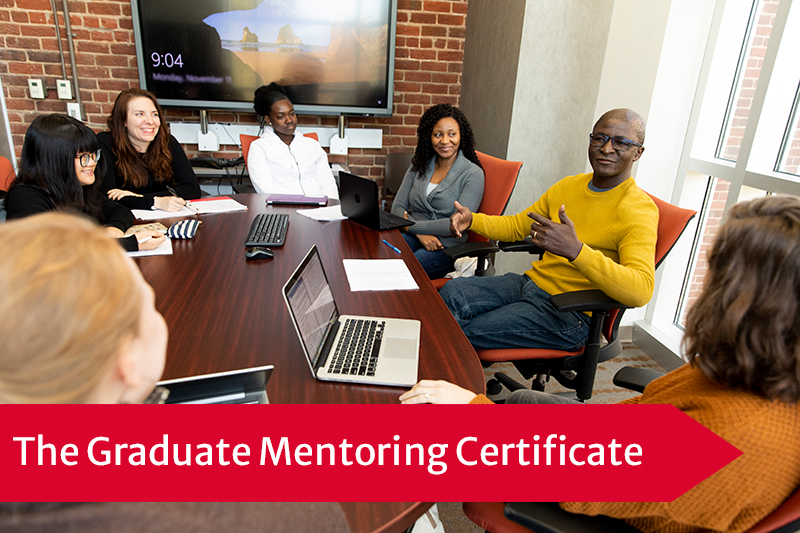
The Graduate Mentoring Certificate

UGA graduate students’ success depends in part on effective mentoring by faculty. The resources on this page provide faculty with keys to unlock students’ potential and tools for developing effective mentoring relationships.
 

2026 Graduate Mentoring Summit

January 9, 2026
9:30am – 12:15pm
Featuring Keynote Dr. Kimberly Griffin, Dean of College of Education University of Maryland, and an engaging panel discussion.
Optional Networking Lunch, 12:15pm -1:15pm
Optional Certificate Session, “Promoting Professional Development,” 1:15pm – 2:45pm
Registration deadline Monday, January 5, 2026
Register here


Graduate Mentoring Certificate BadgeGraduate Mentoring Certificate for Faculty

The Graduate Mentoring Certificate comprises seven modules based on the CIMER Entering Mentoring curriculum, a nationally recognized resource on effective mentoring in graduate education.

  • Open to UGA Faculty that advise graduate students
  • All sessions are 90 minutes and conducted via Zoom
  • Sessions are capped at 30 participants for enhanced engagement
  • Sessions can be completed in any order, except for the final capstone session
  • There is no time limit on completing the series
  • Session completion is tracked via electronic transcript in PEP
  • Faculty completing the program will receive:
    • certificate of completion
    • digital badge
    • invitation into the McCoy-Hutchinson Graduate Mentoring Academy

Certificate Modules

Aligning Expectations

Effective mentorship of graduate students begins with clear, shared expectations. This interactive session explores strategies to establish and revisit expectations between mentors and mentees, helping set a foundation to prevent miscommunication and foster mutual understanding. Faculty will reflect on their own mentoring style, learn practical tools for initiating expectation-setting conversations, and leave with templates and approaches to support productive, aligned mentoring relationships.

This is the foundational session of the seven sessions in the UGA Graduate School’s Mentoring Certificate series for faculty. Faculty are recommended to start with this session if possible.


Promoting Professional Development

Mentors play a key role in supporting the professional growth of their graduate student mentees. This session provides faculty with tools and strategies to actively engage mentees in career exploration, skill development, and goal setting. Participants will learn how to tailor guidance to individual mentee needs, connect mentees with resources, and foster a culture of continuous development across diverse career paths.

This is one of seven sessions of the UGA Graduate School’s Mentoring Certificate series for faculty.


Assessing Understanding & Effective Communication

Strong mentoring relationships with graduate students rely on clear, consistent communication and mutual understanding. This session helps faculty develop skills to assess mentee comprehension, give and receive feedback, and navigate challenging conversations. Participants will explore techniques to enhance communication, reduce assumptions, and create a supportive environment where mentees feel heard and understood.

This is one of seven sessions of the UGA Graduate School’s Mentoring Certificate series for faculty.


Fostering Independence & Cultivating Ethical Behavior

Effective mentors guide graduate student mentees toward increasing independence while modeling and reinforcing ethical practices. This session equips faculty with strategies to balance support and autonomy, promote responsible research conduct, and encourage ethical decision-making. Participants will explore ways to empower mentees to take ownership of their work while upholding integrity and accountability.

This is one of seven sessions of the UGA Graduate School’s Mentoring Certificate series for faculty.


Fostering Well-Being & Enhancing Work-Life Integration

Mentoring relationships with graduate students thrive when well-being is supported. This session helps faculty recognize the importance of supporting mentee mental health, promoting balance, and modeling healthy work-life integration. Participants will explore strategies to create inclusive, supportive environments that encourage self-care, resilience, and sustainable success for both mentors and mentees.

This is one of seven sessions of the UGA Graduate School’s Mentoring Certificate series for faculty.


Mentoring Across Differences

Effective mentorship of graduate students requires awareness, empathy, and adaptability across lines of identity, experience, and perspective. This session supports faculty in developing inclusive mentoring practices by exploring how differences—such as race, gender, culture, and background—shape the mentoring relationship. Participants will gain tools to build trust, address bias in diverse mentoring contexts, and foster engagement and a sense of belonging by strengthening professional networks.

This is one of seven sessions of the UGA Graduate School’s Mentoring Certificate series for faculty.


Capstone: Mentoring Approach and Plan

In this capstone session, faculty will synthesize insights from previous modules to articulate their personal graduate mentoring philosophy and draft an action plan. Through guided reflection and peer feedback, participants will outline goals, strategies, and practices that align with their values and mentees’ needs—creating a roadmap for intentional, effective mentorship.

This is the final session of the UGA Graduate School’s Mentoring Certificate series for faculty. Prerequsite: completion of all six modules of the series.


Mentoring Resources for Faculty

Mentor-Mentee Compacts for Academia

Graduate students and faculty members may find it beneficial to use mentorship compacts to communicate goals and expectations for working together. The Center for the Improvement of Mentored Experiences in Research (CIMER) maintains a list of example mentor-mentee compacts that can be adapted for use in graduate mentoring relationships.

Individual Development Plans

There are numerous free resources that you can use to facilitate career planning and exploration. Examples include ImaginePhD and MyIDP. These sites will allow students to create an individual development plan (IDP) – a tailored professional development itinerary for your graduate career based on skills, interests, and goals.

Students and faculty interested in structured mentoring conversations may consider using Individual Development Plans (IDPs) as a way of guiding interactions with their mentor/mentee.

Click here to submit the IDP and  here to submit the MMC.

Resources from the Council of Graduate Schools

National Research Mentoring Network

NRMN focuses implementing and disseminating innovative and evidence-based mentoring practices in research settings. Visit their website for resources for students, faculty, and researchers at all career stages.


Past Graduate Mentoring Summits

The 2025 Inaugural Graduate Mentoring Summit, held on January 17, 2025 at Studio 225, officially launched UGA’s Graduate Mentoring Certificate. The program included a panel discussion of effective mentoring practices across UGA graduate programs, and a keynote presentation by Dr. Erin Dolan who provided key takeaways from her renowned research on graduate mentoring practices. The event was followed by a networking lunch and the first session of the certificate series – Aligning Expectations.

View some pictures from the event on Instagram @ugagraduateschool.


Contact

For questions about graduate mentoring at UGA or the resources described above, contact gradprofdev@uga.edu.


Unlocking potential. Building futures.

Apply Today